
Part One – Why we should be optimistic

Dedicated people, a continuing professionalising of the sector and growing conversations with advisers are just a few of the reasons the philanthropic sector in Australia continues on a positive trajectory. Earlier this year the Unlocking Generosity report, commissioned by the Minderoo Foundation and the Edward Alaxander Foundation, challenged our collective fundraising goals for 2030. The more I reflect on the figures in the report and examine past data, the more I consider these goals not just achievable but perhaps conservative. I believe, with informed optimism and sound leadership, we are already on track to exceed the targets.
The journey so far has shown Australians continue giving in the face of economic downturns. Education and professionalism in the sector is at an all time high. A record 1,495 people attended the 2026 FIA Conference and Australia now has the third highest representation of Certified Fundraising Executives (CFRE), the internationally recognised certification for excellence. Estate and financial advisers have started to increase philanthropic conversations with clients. Australia has multiple universities with centres and courses dedication to researching and teaching philanthropy subject matter. This is the best environment there has ever been to make giving an easy choice.
As will be shown; how people give, who gives and how much has and will change, and in line with recent trends and reports from overseas it is likely that less people will give more. There are other issues flagged by commentators for consideration, and this is not to downplay the clear impact cost of living pressures have on delivering services for the sector, however, the generosity of people will ensure giving continues.
The first stop on this, at least three-part, journey is a look at tax deductible giving. Thanks to the work of the Australian Centre for Philanthropy and Nonprofit Studies (ACPNS) there is easy access to data that informs the graph below.
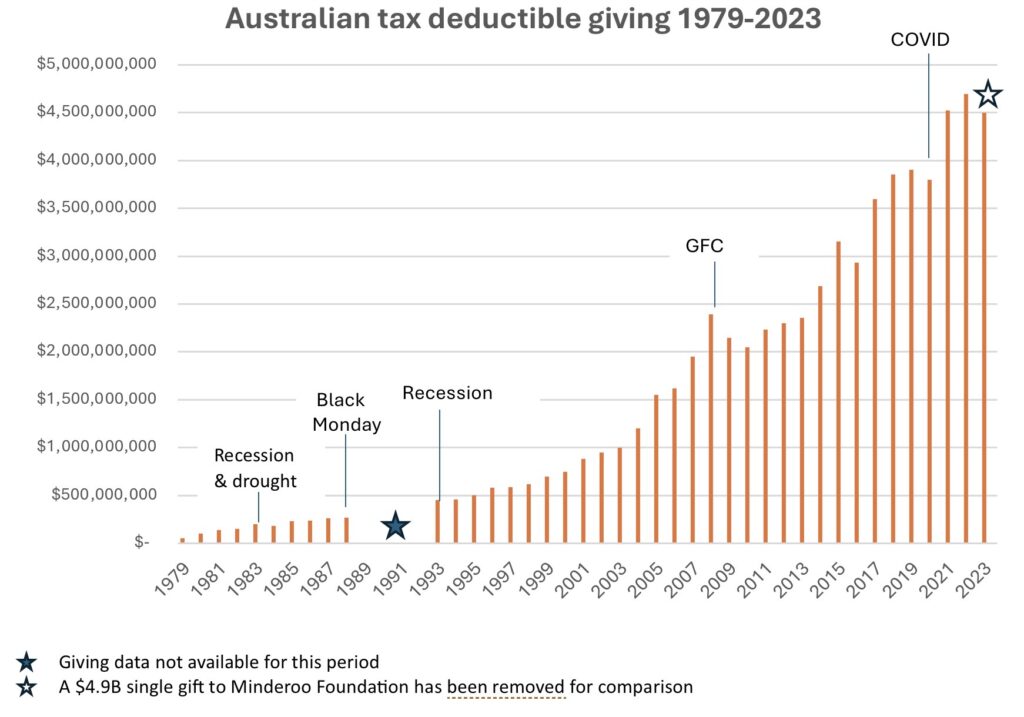
Australian giving is resilient. As the graph attests, gifts made by Australian’s continued on an upward trend despite the economic conditions. Following the fuel crisis and recession of the 1970’s giving remained constant despite years of market returns. In 1992/93 Following the “recession we had to have” giving increased.
After GFC in 2008 there were two years of lower giving, dropping from $2.4B in 2007/08 to $2B in 2010/11 before gradually rising to almost $3B in 2014/15. In fact, this was the only time tax deductible giving took more than a year to recover from a reduction in total giving. COVID to had little effect on giving. A small drop in 2019/20 was followed by a boom year in 2020/21 with tax deductable giving rising to $4.5B.
The overall giving picture is amplified when you consider total giving including bequests and major gifts. While total giving has grown, there are changing patterns underlining the figures for further exploration including who gives, how much they give, what it means for fundraising practice and how the giving stacks up against the growing costs of delivering services and providing impact.
On a practical level, the message is clear. When socio-economic times are tough, don’t stop communicating with your supporters. Don’t stop letting them know how you are striving to achieve your purpose. Often, those that can give will give more and those that can’t will know where to direct support when they can. Only the organisations that stopped asking and connecting with their supporters stopped getting gifts. Even in the most prosperous years represented in the graph, no one simply woke up with an epiphany to give to charity, they were all asked.
To follow: Part Two – Look what happens when you include bequests and other fundraising..
- Minderoo Foundation, & Edward Alexander Foundation. (2026). Unlocking generosity: The potential gains from expanding access to advice on charitable giving (B. Ruting, Author). Brad Ruting Economic Consulting.
- Fundraising Institute of Australia www.fia.org.au
- Mcgregor-Lowndes, Myles, Balczun, Marie, & Williamson, Alexandra (2025) An Examination of Tax-Deductible Donations Made by Individual Australian Taxpayers in 2022-23: ACPNS Working Paper No. 79. The Australian Centre for Philanthropy and Nonprofit Studies (ACPNS), QUT, Brisbane, Qld. [Working Paper]

Leave a Reply